Facial Analysis: What AI Can Actually Read From Your Face
A single photo contains more health information than a waiting-room clipboard. Here's how AI facial analysis measures skin, symmetry, and aging — what it legitimately reveals about your health and appearance, where it falls short, and how to get assessed free.

Dermatologists have done facial analysis by eye for a century — skin texture, sun damage, volume loss, the thousand small signals that say more about your health than your age. AI turned that expert glance into a measurement. Modern facial analysis doesn't just tell you you're attractive or tired; it quantifies specific, trackable features, and some of them predict how fast you're aging on the inside.
The 60-second answer
- • Facial analysis uses AI to measure skin texture, pigmentation, symmetry, proportions, and visible aging from a photo.
- • Perceived facial age is a real longevity signal — looking older than your years correlates with higher biological age and disease risk.
- • Most of what it measures is modifiable: UV exposure, sleep, smoking, stress, and diet write themselves onto your face.
- • A camera can't see VO2 max or blood markers — pair any facial tool with a full biological age assessment.
- • Start free: the Aevon Health Assessment scores the habits behind both beauty and aging in ~3 minutes, no photo required.
What facial analysis actually measures
Strip away the marketing and every facial analysis tool — from research systems like FaceAge to consumer beauty scanners — reads the same five feature families:
- Skin texture and surface. Pore visibility, fine lines, roughness, and hydration sheen. This is the single strongest input for perceived-age models and the one most responsive to sunscreen, retinoids, and sleep.
- Pigmentation and tone. Sun spots, redness, under-eye darkness, and evenness of color. Uneven pigmentation is read by both humans and algorithms as age and fatigue — often more strongly than wrinkles.
- Volume and structure. Fullness of the cheeks and temples, jawline definition, and under-eye hollowing. Facial fat-pad descent is one of the clearest structural markers of aging, and it's partly driven by body composition and training.
- Symmetry and proportion. The classic beauty-assessment inputs: ratios between facial thirds, eye spacing, and left-right symmetry. Research links symmetry to perceived attractiveness, but the effect size is smaller than pop culture suggests — skin quality dominates.
- Expression and muscle patterning. Tension patterns around the brow and mouth. Chronic stress literally shapes resting facial expression, and algorithms read it as both age and fatigue.
The science: your face is a health readout
This isn't mysticism — it's epidemiology. In the Longitudinal Study of Aging Danish Twins, perceived age rated from photographs predicted survival: the younger-looking twin tended to live longer, and perceived age tracked physical and cognitive function. AI versions of the same idea now correlate with mortality risk and comorbidity burden in clinical populations. As we covered in our deep-dive on face age tests, the gap between how old you look and how old you are behaves like a summary of accumulated physiological wear.
The mechanism is straightforward: the skin and soft tissue of the face are exposed, metabolically active organs. They record UV damage (photoaging accounts for the majority of visible facial aging), smoking (measurably more wrinkling in smoking twins), sleep debt (impaired barrier recovery and periorbital changes — see the sleep-aging data), and glycemic load (sugar-driven glycation stiffens collagen). Facial analysis works because lifestyle is legible.
Facial analysis vs. beauty filters: measurement vs. fiction
A beauty filter changes your face to match a template. Facial analysis measures your face as it is — and that difference matters more than it seems. Filters train dissatisfaction against an impossible reference; analysis gives you a baseline you can actually move. The healthy way to use these tools is the way you'd use a bathroom scale or a fitness tracker: take a measurement, change an input, re-measure in 8–12 weeks, and ignore the day-to-day noise.
Where facial analysis falls short
A camera sees one organ system, under one lighting condition, at one moment. It cannot see cardiorespiratory fitness — the strongest single predictor of all-cause mortality (our VO2 max guide covers why). It can't see blood pressure, HbA1c, inflammation, or sleep architecture. Someone can photograph 38 at 50 with arteries that say otherwise, and the reverse happens constantly. Facial analysis is a useful screening layer, never a verdict. The complete picture comes from combining surface signals with lifestyle, fitness, and biomarker data — the approach in our biological age test comparison.
The privacy question you should ask first
A selfie is biometric data — permanent, unchangeable, and uniquely identifying. Before uploading your face to any analysis tool, check four things: whether processing happens on your device or on a server, how long the photo is retained, whether it's used to train models, and whether you can delete it. If the policy is vague, walk away. Questionnaire- based assessments, including Aevon's, require no photo at all — which removes the entire question while still measuring the inputs that determine what a camera would find.
The evidence-based protocol for a better score
Whatever a facial analysis reports, the improvement plan is the same, because the inputs that age a face are the inputs that age a body:
- Block the sun. Daily broad-spectrum SPF 30+ on face, neck, and hands — the highest-ROI intervention in all of dermatology.
- Sleep 7–9 hours. Collagen synthesis and skin repair peak in deep sleep (the protocol).
- Train. Resistance work preserves facial and skeletal muscle; aerobic fitness slows the systemic aging that surfaces in skin.
- Eat for structure. Adequate protein, omega-3s, and polyphenol-rich plants; minimize added sugar and alcohol (see the longevity diet evidence).
- Manage stress. Cortisol degrades collagen and writes tension into resting expression — track it alongside everything else.
- Re-measure on a schedule. Every 8–12 weeks, same conditions, and pair surface metrics with whole-body numbers.
Free · 3 minutes · No photo needed
Measure what your face is reflecting
The free Aevon Health Assessment scores ten longevity domains — sleep, nutrition, stress, fitness, and more — and returns your Wellness Score and biological age estimate: the numbers behind the face.
Take the free assessment →Frequently asked questions
This article is for educational purposes and is not medical advice. Facial analysis tools are screening instruments, not diagnoses. Consult a qualified clinician about any health concerns.
Keep reading
Related from the Aevon Journal

AI Health Coach: What It Actually Does and Whether You Need One
A personal trainer, nutritionist, and sleep specialist in your pocket — that's the pitch. What an AI health coach really does, what the evidence says about whether it works, where it falls short, and how to try one free.
Read →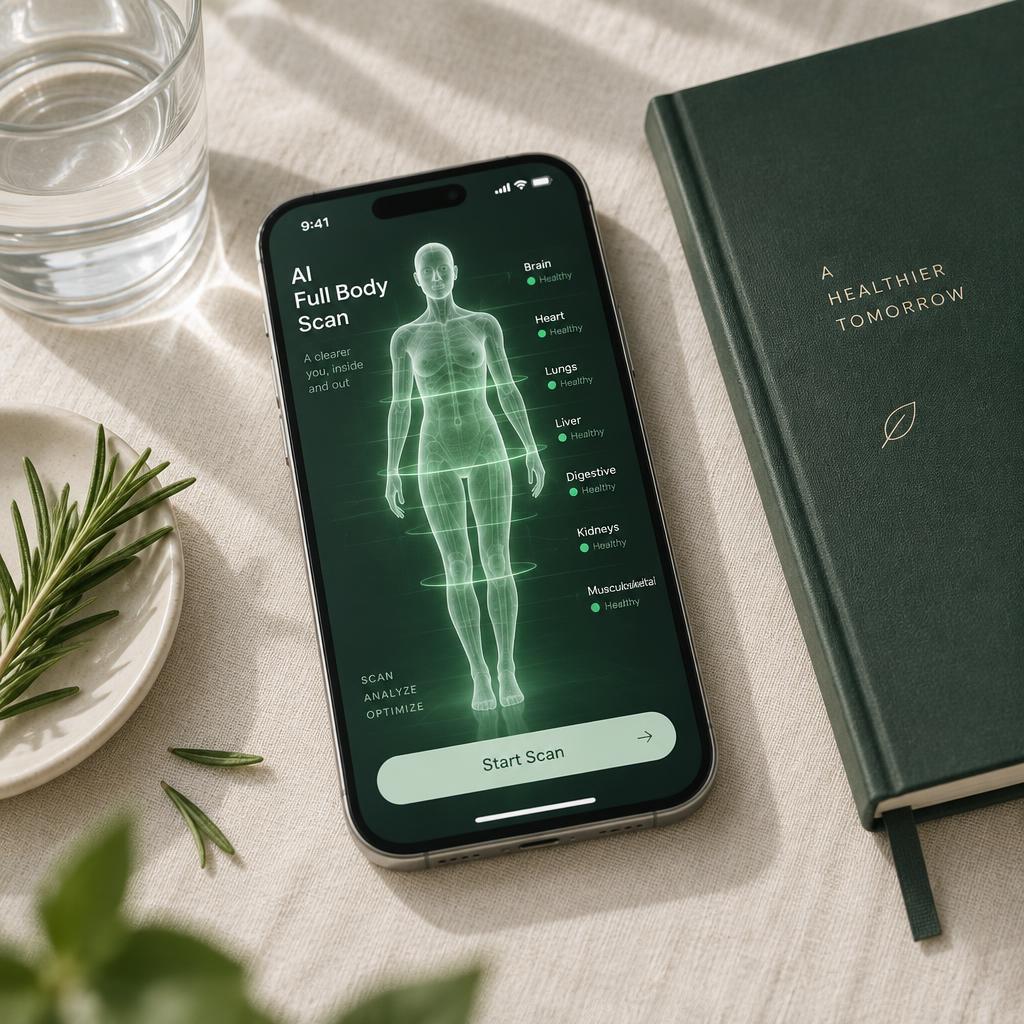
Full Body Scan: Cost, What It Shows, and Whether It's Worth It
Whole-body MRI, full body CT, DEXA and AI body scans all promise to see everything. What each one really costs, what it can and can't detect, the false-positive problem — and the free scan to run first.
Read →
Face Age Test: How Old Does Your Face Really Look?
Face age tests are everywhere — and the science underneath them is real. How AI estimates your perceived age, why looking older than your years predicts health outcomes, and how to measure the aging that actually matters.
Read →