Full Body Scan: Cost, What It Shows, and Whether It's Worth It
Whole-body MRI, full body CT, DEXA, and the new generation of AI body scans all promise the same thing: see everything, catch it early. Here's what each one actually costs, what it can and can't detect, and the cheaper scan most people should run first.
The pitch is irresistible: one hour in a machine and you'll know whether anything is hiding inside you. Consumer whole-body MRI has become the status symbol of preventive health, and AI body scans have made the same promise free and instant. Both are useful. Neither does what the marketing implies. Here's the honest version — cost by cost, finding by finding.
The 60-second answer
- • A consumer whole-body MRI costs $1,000–$2,500; full body CT $500–$1,500; DEXA $50–$150; an AI health scan is free.
- • Imaging shows structure — tumors, aneurysms, lesions. It cannot see fitness, glucose, lipids, blood pressure or sleep, which cause most premature death.
- • Roughly 15–30% of whole-body scans find something incidental; most turn out to be nothing after further testing.
- • No major guideline body recommends whole-body screening for healthy, asymptomatic adults.
- • Start with the free Aevon AI health scan: ten longevity domains, a Wellness Score and a biological age estimate in ~3 minutes.
What is a full body scan?
"Full body scan" is a marketing umbrella over four very different technologies. Knowing which one you're being sold is the whole game:
- Whole-body MRI. Magnetic resonance imaging of brain, spine, chest, abdomen and pelvis in a single session, usually without contrast. No ionizing radiation. The Prenuvo/Ezra category.
- Full body CT. X-ray computed tomography, faster and cheaper than MRI but delivering roughly 10 mSv of ionizing radiation — one reason radiology societies discourage it as routine screening.
- DEXA (DXA). A low-dose scan that measures body fat, lean mass, visceral fat and bone density. It finds no tumors, but it produces numbers you can actually train against.
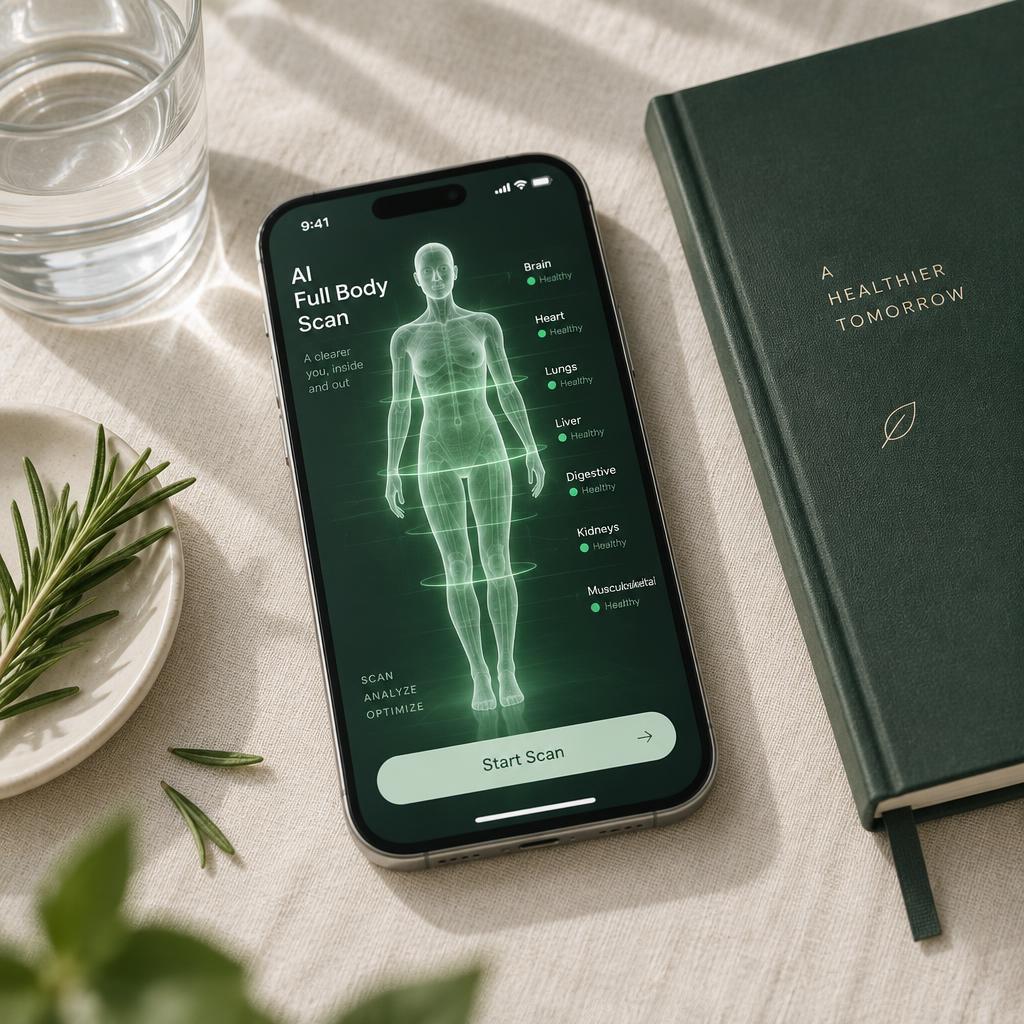
- AI body scan / AI health scan. Software, not radiology. Photo-based tools estimate body composition and measurements; questionnaire-and-data tools estimate biological age and risk across lifestyle domains. Zero radiation, zero cost, instant.
How much does a full body scan cost?
Prices vary by city and provider, but the US ranges in 2026 look like this:
| Scan type | Typical cost | Time | Best used for |
|---|---|---|---|
| Whole-body MRI | $1,000–$2,500 | 45–60 min | High genetic risk; specific unexplained symptoms |
| Full body CT | $500–$1,500 | 10–30 min | Clinician-ordered investigation, not screening |
| Coronary calcium (CAC) | $100–$400 | ~15 min | Cardiac risk in midlife adults — high value per dollar |
| DEXA body composition | $50–$150 | ~10 min | Visceral fat, lean mass and bone density tracking |
| AI health scan | Free | ~3 min | Biological age, risk domains, where to start |
Insurance rarely covers screening imaging in people without symptoms, so most of this is out of pocket — and the follow-up testing triggered by a finding usually is too.
What does a full body scan actually detect?
A whole-body MRI is genuinely good at what it does: it can reveal solid tumors above a few millimeters, brain aneurysms, aortic dilation, kidney and liver lesions, spinal degeneration and structural abnormalities you'd otherwise never know about. Cases of early cancers caught this way are real and life-changing for those people.
What it cannot see is everything that kills most people. Cardiovascular disease, metabolic disease and dementia don't announce themselves as a lump on an image years in advance; they show up as blood pressure, apoB and LDL, HbA1c, visceral fat, cardiorespiratory fitness, sleep quality and inflammatory load. An MRI tells you nothing about your VO2 max — the single strongest predictor of all-cause mortality we have — or about the sleep debt quietly accelerating your aging.
The incidentaloma problem
The uncomfortable statistic behind consumer imaging: depending on the study and protocol, somewhere around 15–30% of whole-body scans in healthy people turn up an incidental finding. The large majority are benign — cysts, small nodules, harmless anatomical variants — but you can't know that from the image alone. Each one launches a cascade: repeat imaging, specialist visits, sometimes a biopsy, always months of worry.
This is why the American College of Radiology, the USPSTF and the FDA have all declined to endorse whole-body screening for asymptomatic adults: there is no randomized evidence that it reduces mortality, and there is clear evidence it produces overdiagnosis. That's not an argument against ever scanning. It's an argument for scanning with a question.
AI body scans: what the software can and can't do
The newer category replaces the magnet with a model. Photo-based AI body scans estimate body-fat percentage and circumference measurements from two smartphone images, typically landing within a few percentage points of DEXA — good enough to track direction, not precise enough to argue over a single reading. Facial AI goes further, reading skin and structural aging signals (we covered the evidence in our facial analysis guide and face age test breakdown).
The most useful AI scan, though, isn't imaging at all. It's the kind that ingests what you already know about yourself — training, sleep, diet, stress, labs, family history — and converts it into a biological age estimate and a ranked list of what to fix first. That's the approach behind AI-powered longevity intelligence: not new pictures, but better decisions from existing data. It cannot detect cancer, and no honest tool will claim otherwise.
A smarter screening order
If your goal is more healthy years rather than more images, run the cheap, evidence-backed steps before the expensive, evidence-thin one:
- Free AI health scan. Establish your baseline biological age and find the two domains costing you the most years — takes three minutes.
- Core numbers. Blood pressure, lipid panel with apoB, HbA1c, waist circumference, liver enzymes. Under $200 and higher-yield than any image.
- Guideline screening for your age and sex. Colonoscopy, mammography, cervical screening, low-dose chest CT if you qualify, annual skin check. These are the scans with mortality evidence behind them.
- Coronary calcium score if you're 40+. A few hundred dollars for genuine reclassification of cardiac risk.
- DEXA for composition and bone. Track visceral fat and lean mass twice a year rather than chasing scale weight.
- Whole-body MRI last — if you have a high-risk genetic syndrome, a strong family history, persistent unexplained symptoms, or simply the disposable income and a clear-eyed understanding of the false-positive risk.
Free · 3 minutes · No radiation, no cost
Run the AI scan before you book the MRI
The free Aevon Health AI scan evaluates ten longevity domains and returns your Wellness Score, biological age estimate and a personalized Health Blueprint — the numbers that tell you whether imaging is even the right next step.
Take the free AI health scan →Frequently asked questions
This article is for educational purposes and is not medical advice. Prices are typical US ranges and vary by provider. Aevon Health does not perform medical imaging and cannot diagnose disease. Discuss screening decisions with a qualified clinician.
Keep reading
Related from the Aevon Journal

Facial Analysis: What AI Can Actually Read From Your Face
A single photo holds more health information than a clipboard. How AI facial analysis measures skin, symmetry, and aging, what it reveals about your health and appearance — and how to get assessed free.
Read →
Face Age Test: How Old Does Your Face Really Look?
Face age tests are everywhere — and the science underneath them is real. How AI estimates your perceived age, why looking older than your years predicts health outcomes, and how to measure the aging that actually matters.
Read →
AI Longevity: How AI-Powered Longevity Intelligence Actually Works
Wearables, labs and habit apps produce data; almost none of it changes behavior. Here's what AI-powered longevity intelligence really does — aggregate, estimate, rank, prescribe — and what it can't do.
Read →