Creatine Benefits for Women: What the Evidence Actually Shows
For 30 years creatine was marketed to male lifters. The last decade of research has quietly made it one of the best-supported supplements for women — for strength, cognition, bone, and healthy aging. Here's the full picture, without the bro-science.
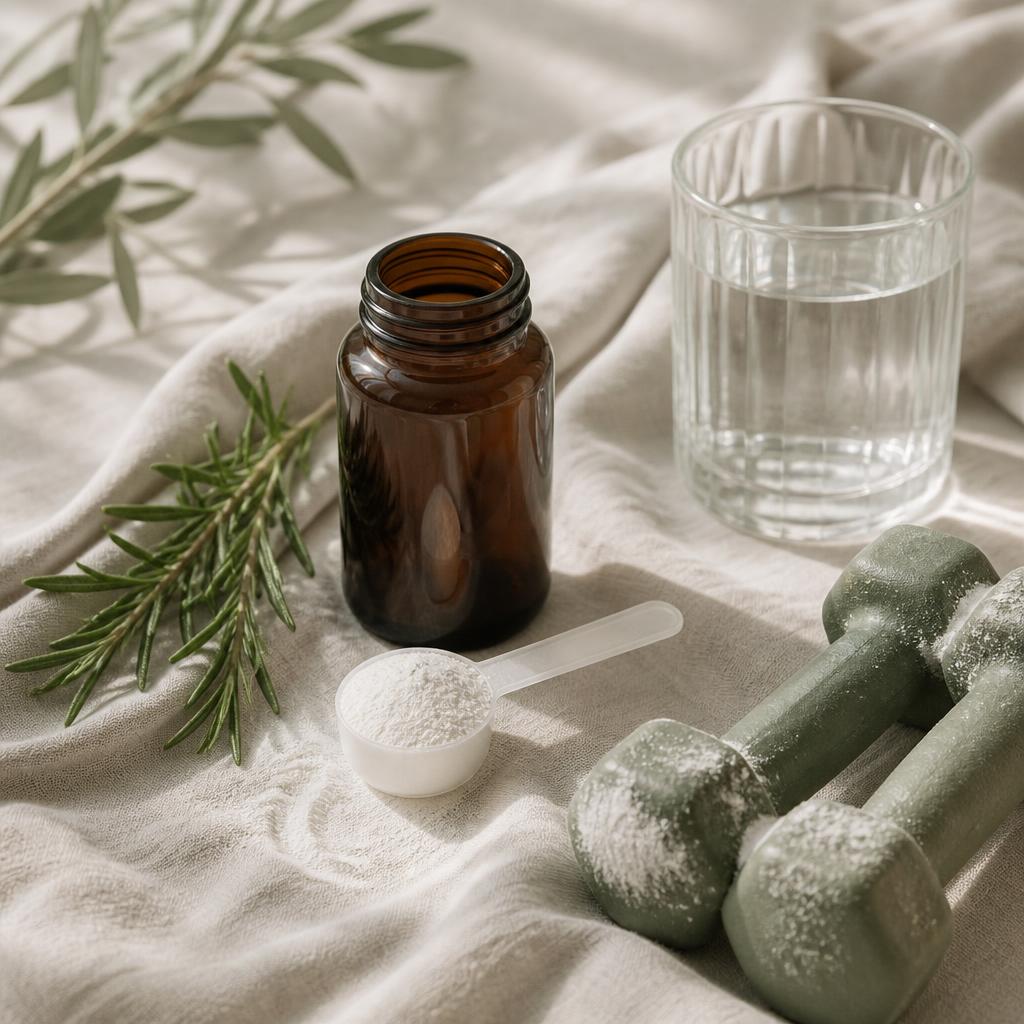
Creatine monohydrate is the most-studied performance supplement in existence, with more than 1,000 published trials. Yet women make up a small minority of participants — leaving most women to make decisions based on messaging designed for 20-year-old male athletes. The evidence in female populations is now clear enough to fix that.
The 60-second answer
- • Dose: 3–5 g/day of creatine monohydrate, every day. No loading needed.
- • Proven in women: +10–15% lower-body strength, +1–2 kg lean mass in 8–12 weeks, better memory under sleep deprivation, preserved bone density with lifting.
- • Won't: Make you bulky, cause hair loss, or damage kidneys in healthy adults.
- • Will: Add 0.5–1.5 kg of intracellular water in muscle in the first month — that's the point.
- • Best for: Anyone lifting, running, entering perimenopause, or wanting to protect long-term muscle and bone.
- • Skip if: You have advanced kidney disease, or are pregnant/breastfeeding without clinician sign-off.
Why women get less benefit from a normal diet
Creatine is stored in muscle at ~120 mmol/kg dry mass in most adults. It comes from two sources: your body synthesizes about 1 g/day, and you get another 1–2 g from red meat and fish. Women, on average, eat less meat than men and carry ~15–20% less muscle mass, which means baseline creatine stores in female muscle are typically 70–80% of saturation — meaning most women have more headroom to benefit from supplementation than most men.
The human evidence in women, ranked by outcome
These are effect sizes from randomized controlled trials in female participants:
| Outcome | Typical effect | Evidence |
|---|---|---|
| Lower-body strength (squat, leg press) | +10 to +15% | Strong (multiple RCTs) |
| Lean body mass (8–12 wk + lifting) | +1 to 2 kg | Strong |
| Sprint / repeat-effort performance | +5 to +15% | Strong |
| Memory & mental fatigue (esp. sleep-deprived) | Moderate improvement | Moderate |
| Bone mineral density (postmenopausal, + lifting) | Preserved / small gain vs. placebo loss | Moderate (Chilibeck, 12-mo RCT) |
| Depressive symptoms (adjunct) | Small-to-moderate | Emerging |
| Recovery from resistance training | Reduced soreness & CK markers | Moderate |
1. Strength and muscle: the headline benefit
Across a 2021 meta-analysis of trials in women (Forbes et al.), creatine plus resistance training produced roughly 1.5 kg more lean mass and 10% greater lower-body strength than resistance training alone over 8–12 weeks. This isn't testosterone bulk — it's more efficient contractions, better phosphocreatine replenishment between sets, and modest hypertrophy. Practically, it means more usable reps at the same weight, faster recovery between sessions, and a bigger training stimulus.
2. Brain: memory, mental fatigue, and sleep debt
Your brain uses roughly 20% of your body's energy at rest, and neurons rely on the creatine–phosphocreatine system for fast ATP just like muscle does. In several RCTs, creatine improved working memory and reduced mental fatigue, with the largest effects in people who were sleep-deprived, vegetarian, or aged over 60 — all groups with lower baseline stores. A 2024 trial found a single 0.35 g/kg dose acutely improved cognitive performance after a night of sleep loss.
3. Bone density and perimenopause
Around age 45–55, estrogen loss accelerates bone and muscle loss simultaneously. Dr. Philip Chilibeck's 12-month RCT in postmenopausal women found that creatine + resistance training preserved femoral neck bone density versus a significant loss in the placebo group. Combined with lifting, creatine is one of the few non-pharmaceutical interventions with human data for both muscle and bone in perimenopause.
4. Mood, depression, and the brain-energy hypothesis
Depression is associated with reduced brain phosphocreatine on MRS imaging. Several small trials — mostly in women, since depression is roughly twice as common in women — show creatine augments SSRI response, with meaningful drops in depression scores when added to standard antidepressants. It is not a replacement for treatment, but it is a plausible, low-risk adjunct worth discussing with a clinician.
How to take creatine: the simple protocol
- Form: Creatine monohydrate — ideally Creapure®-certified. Skip HCl, ethyl ester, and 'advanced' blends; they cost more and don't outperform.
- Dose: 3 g/day if you weigh under ~65 kg (145 lb), 5 g/day above. That's it.
- Loading? Not needed. 5 g/day saturates muscle in ~3–4 weeks with fewer GI side effects than a 20 g loading phase.
- Timing: Post-workout with a carb + protein meal is slightly best. Any time works — consistency matters more.
- Cycling: Don't. Continuous daily dosing is what the studies use.
- With coffee? Fine. The old caffeine-blocks-creatine study used doses no one takes.
- Hydration: Drink a normal amount of water. Creatine pulls water into muscle cells, not out of them.
What creatine won't do
- Make you bulky. Female physiology doesn't allow it without pharmacological help.
- Damage kidneys or liver. In every long-term RCT in healthy adults, standard markers are unchanged.
- Cause hair loss. Based on a single 2009 DHT study that has never been replicated and didn't measure hair.
- Replace training. The strength and bone effects only show up when combined with resistance exercise.
- Burn fat. Creatine is not a fat-loss supplement. Body composition can improve because muscle mass increases, not because fat decreases.
Where creatine fits in a longevity stack
Muscle mass and strength are among the strongest predictors of all-cause mortality after age 50. Creatine + resistance training is the intervention with the biggest effect on both. Combined with a base of protein (1.6 g/kg/day), vitamin D, omega-3, and consistent Zone 2 cardio, it belongs in the small evidence-based core of a longevity protocol — right alongside sleep and training.
Frequently asked questions
See where creatine fits in your protocol
The free Aevon Health Assessment maps your nine longevity domains, estimates your biological age, and shows exactly which levers — strength, sleep, nutrition, supplements — will move your Wellness Score fastest. Three minutes, no card required.
Start free assessment →Aevon Health is educational wellness technology, not a medical device. Insights are directional and never replace advice from a qualified clinician. Talk to your doctor before starting any supplement — especially if you're pregnant, breastfeeding, or have kidney disease.
Keep reading
Related from the Aevon Journal
AI Health Coach: What It Actually Does and Whether You Need One
A personal trainer, nutritionist, and sleep specialist in your pocket — that's the pitch. What an AI health coach really does, what the evidence says about whether it works, where it falls short, and how to try one free.
Read →
Full Body Scan: Cost, What It Shows, and Whether It's Worth It
Whole-body MRI, full body CT, DEXA and AI body scans all promise to see everything. What each one really costs, what it can and can't detect, the false-positive problem — and the free scan to run first.
Read →
Facial Analysis: What AI Can Actually Read From Your Face
A single photo holds more health information than a clipboard. How AI facial analysis measures skin, symmetry, and aging, what it reveals about your health and appearance — and how to get assessed free.
Read →